Showing posts with label Israel. Show all posts

Sunday, April 10, 2011

Gilad Shalit is still alive

Just a small reminder.


 ~venti cafe latte~

Not to bash the Times, but...

The image alone, from the Times' "Israel Scours Palestinian Village in Hunt for Killers", looks right out of a movie.

A Palestinian girl, Rabah Abd al-Karim, 6, with members of her family  at the doorway to her house in Awarta, West Bank, that was searched repeatedly by Israeli soldiers during a door to door hunt for the killers of a family in neighboring Itamar.

It's unsettling to read about raids of Palestinian houses, "children crying...in fright...of" Israeli soldiers, a "dingy, sparsely furnished...house, with bare cement-block walls" where soldiers "broke all the closets and the family’s first, newly acquired washing machine". Unnecessarily brutal disruption of civilian life is shocking.


Yet I was even more shocked to see that the Times considers the hunt for the Fogels' killers in itself an emotional saga, a human interest story that the murder never was. Let us be totally honest: There was no equivalent article that described the Fogel funeral; no pretty imagery like "dingy", "sparsely furnished", "bare cement-block walls"; no similarly tearful descriptions of Israeli children dealing with post-attack trauma.


It seems as if the story of the children (albeit settlers) who lost their parents and siblings isn't especially compelling to Times readers; people would much rather read about the children who lost their newly acquired washing machine.


~mango passion fruit tea~

Monday, April 4, 2011

A Thousand Words

NYTimes chose an interesting image for yesterday's headline, "In Israel, Time for Peace Offer May Run Out". I won't even enter the discussion on how misplaced this article is, how utterly irrelevant the Middle Eastern mentality finds sentences like:
With revolutionary fervor sweeping the Middle East, Israel is under mounting pressure to make a far-reaching offer to the Palestinians or face a United Nations vote welcoming the State of Palestine as a member whose territory includes all of the West Bank,Gaza and East Jerusalem.
Or how statements like 
“We want to generate pressure on Israel to make it feel isolated and help it understand that there can be no talks without a stop to settlements,” said Nabil Shaath, who leads the foreign affairs department of Fatah, the main party of the Palestinian Authority. 
....are nothing new.


Or how the PA's goals, in gaining membership in the UN and then accusing Israel of "occupying land belonging to a fellow UN member", don't make Israelis blink an eye. Since when has the UN had any real influence over Israeli policy? Operation Cast Lead, the Mavi Marmara incident last year, strikes on Gaza in retaliation for rockets into southern Israel: Israel clearly makes its decisions regardless of the United Nations' disapproving frowns and incessant banging of the gavel.


Let's not forget, after all, that it's a conglomerate of countries that includes Qaddafi's Libya, Egypt, Syria, North Korea; an organization which has invited Ahmadinejad to speak, and in heat of the turmoil of the Egyptian revolution, only found time to convene over Israel's imperialistic settlements. 

But let us turn to this most artfully shot image: 
Palestinians prayed near Israeli soldiers on Friday. They were protesting land confiscation in the village of Qusra, near Nablus.


Is this really the only type of protests that goes on? Peaceful prayer, in prostration? Oh yes, the image is beautiful, compelling. Kudos to you, NYTimes photographer, on 
excelling artistically.

But let's not kid ourselves. You craft a pretty bedtime story (not unlike that of Miral), but your educated readers? They're rolling their eyes.


~ cappuccino ~
 

Monday, March 21, 2011

Rifts in the Face of Tragedy

An op-ed I wrote for The Jerusalem Post, which you can also read here:

The media's bias isn't something I like to pounce on often; even if I disagree with an article or headline, I accept its attempt at balance. And as a journalism student, I am constantly seeking objectivity in everything I read, with every newspaper article and news broadcast becoming an object of scrutinizing study and analysis.

I write this as the girl who struggled and succeeded to screen liberal films that expose the Palestinian side of the conflict in a university that is mostly uniform politically. I write this as a Jew who corresponds with Israeli Arab pen pals, as a daily reader of BBC, Haaretz, The New York Times, Al-Jazeera, The Guardian, and The Jerusalem Post, as a student activist who is organizing an apolitical demonstration in Times Square in support of peace in the Middle East:

The outburst that happened in response to a story that really isn't at all complicated -- five Jews stabbed to death in their home on Friday night by an Al-Aqsa terrorist-- has been used to very artfully condemn not the murder itself, but the settlements and Israeli policies. It has completely crossed the lines of moderation and balance.

Yet what shocks me more than the response from the media, and that of the international community, is the response I hear from fellow Jews here in America.

The morning after the attack, a friend of mine studying in an American university commented offhand to me that "the people killed were not killed for being Jews, but for being settlers, and that is not a Jewish question. It's a very important Israeli political question."

"Insofar as Jews died," she added, "It is very sad-- but it is as sad as when a family is killed by a car crash."

As for the political activity going on on Facebook, in regard to my friends posting outraged links and images to the latest updates on the attack, she said, "It wouldn't hurt your friends to have someone challenge their propaganda."

Her words continue to ring in my head, days later. I still find myself in shock, and even pain, over them. Killed for being settlers alone. As sad as if they were killed by a car crash.

There is a growing movement among left-wing thinking Jews to be absolutely paranoid of anything that smacks of conservatism. That includes, apparently, mourning the deaths of the Fogels-- precisely because BBC and CNN report the Itamar killings with quotations, we readers ourselves have begun to question our own emotional responses. Perhaps, one thinks, the 'intellectual', 'reasonable' and even fashionable way of responding is to simply, coolly, distantly, point to maps of settlements. To disregard the naked hatred in this act, and to call those who find the attack anti-Semitic, 'ethnocentric'. The logic is as follows: Those who feel emotionally affected by this must be supporters of the settlers, therefore politically conservative and possibly even religious, therefore irrational, and therefore racist.

Most political discussions for us college students take place not in the coffeeshops or salons of old, but rather via the world of social media, mostly Facebook and occasionally Twitter. The debates have grown heated, and within the Jewish student community, I'm finding that many of my friends are posting comments like, "There are people murdered all over the world. EVERY DAY. This is no different! Get a grip, people." They equate those who decry terrorists as animals, to Nazis' dehumanizing of Jews. Blanket statements are made, accusing other Jews of having waited 'for a Palestinian Arab to kill someone so they could justifiably rant against "hate-filled Arabs who train their children to kill Jews"'. 

The fact that parallels are being drawn between this killing and the happenstance of a car crash, or that this is seemingly justified by the 'settler' label, or the fact that there are genocides going on in Darfur and therefore this is insignificant, underlies a disturbingly shifting view amongst Jews (both American and Israeli) towards Israel and towards each other. I am forced to wonder about the future of the State and of Diaspora Jewry: where are the young idealists and dreamers of 1948?  It's overwhelmingly discouraging to see such cynicism, self-bashing, and inner fighting often just for the sake of fighting, especially after such bloodshed. 

So in a time in which Jews jump to condemn other Jews of racism, ethnocentrism, and fanaticism, let us remember this:

Five Jews or peaceful civilians or settlers or family members or West Bank residents or Judea and Samaria citizens or breathing feeling thinking laughing crying human beings were just murdered by an Al-Aqsa Palestinian terrorist in the deceptive peace of the Sabbath night. 

To the Jews who use such an event to immediately accuse other Jews of racism (the irony: it takes a hate act done by a Palestinian against Israelis to spawn condemnation of Israeli racism):

I wonder at your chutzpa to dare to taint the pure memory of five innocent human beings with absolutely any prejudices, whether against Jew or Muslim, during such a difficult national tragedy. 

And to the world which uses this act of terror to denounce the Jewish reaction as impetuous and exaggerated:

Know that, despite everything, we refuse to be overtaken by anger and we refuse to hate. Maimonides writes that anger is the worst trait a person could have: 'So too is anger an exceedingly bad quality; one from which it is proper that one distance himself to an extreme. A person should train himself not to anger even on a matter regarding which anger is appropriate.'  The Israeli government as well as the surviving Fogel family have condemned those who take personal revenge and take the law into their own hands. As Prime Minister Netanyahu said, "The law that is taken into one's own hands is no longer law"-- never should a person react upon emotion, upon angry impulse and without rational thought, no matter what his personal reasons. 

Yet sadness? Mourning? That is entirely appropriate, essential even; those who mock it or shrug it off as political radicalism do so callously. In Judaism, the process of loss is crucial to individual as well as collective growth: Jewish tradition enumerates the detailed laws of shiva and shloshim and the year of mourning after a family member passes away. We are commanded to remember, to never forget and to learn from those who have passed on.

And so, dear world, let us mourn our dead in peace-- for to deny respect and validity to emotions in a time like this is to deny the very stuff that makes us human.


~turkish caffe latte ~

Monday, March 14, 2011

Exhibit C: New York Times

Here's an excellent example of the headlines Steuter and Wills, in their At War With Metaphor, describe:
Although they are only a small percentage of what is publicly said and written about the war on terror, it is worth paying special attention to headlines because they are, for a large part of the population, a main source of information; many people glean their knowledge from scanning headlines rather than reading whole articles...four out of five people read only news headlines.
Headlines matter more than we think. The Times' Isabel Kershner chooses her words deliberately, in the aftermath of the Itamar terror attack in Israel:
Emphasis on:
1. Israeli military is the active subject. 
2. Suspicion of Palestinians (and thus probably a false overreaction to a single incident)
3. A hunt. Not a search for murderers, but a merciless hunt.
4. Settlers have been killed: the fact that their house was built on the land they chose is a completely justified reason for what took place. 
Well, at least there are no quotation marks.


~vanilla hazelnut latte~

Exhibit B: BBC. More Quotation Marks.

BBC and CNN must know something we don't, because quotation marks seem to be the latest trend when reporting on attacks on Israel.
Last time, it was a 'terror attack'. 
Now, it's a 'Palestinian'.
By enveloping everything in quotations, media sources have been inviting readers to question the entire Itamar murder story: "Those Israelis say it's a Palestinian, but who knows? After all, it's Israelis speaking." The murderer himself is intangible, a ghost of the IDF's imagination, a mere speculation on the part of the authorities.

Note, here again, BBC writes,
The family...were stabbed to death by an intruder who broke into their home, Israeli media reported.
BBC Images.
Intruder, not terrorist.
Not to mention the photograph of choice: the vicious Israeli soldier in full gear. None of the images of victims and murder scenes that news websites usually gobble up and broadcast for days afterwards; apparently those types of images only work for Muhammed al-Dura moments. 
And last but not least, a classic BBC-style conclusion:

Nearly half a million Jews live in more than 100 settlements built since Israel's 1967 occupation of the West Bank and East Jerusalem.
They are held to be illegal under international law, although Israel disputes this.
BBC must, of course, end a story on a terror attack on Israelis, with a  condemnation of...Israel -- because Israel, with its settlements, just has these types of terror attacks coming.

Exhibit A: CNN


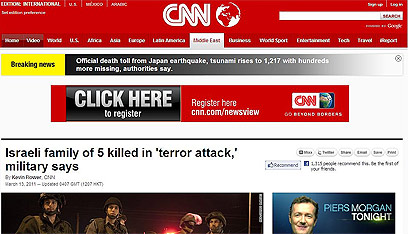
Apparently the terror attack was questionable, hence quotation marks. CNN wasn't exactly sure; perhaps, after all, it was a sheer accident that the couple and their three children were killed in their sleep on Sabbath night. 
CNN:
"According to a military spokeswoman, an intruder entered the Israeli settlement of Itamar near the northern West Bank city of Nablus around 1 am, made his way into a family home and killed two parents and their three children."
'Intruder', and not 'terrorist'. No mention that the murderer was in fact a terrorist, other than a suspected 'terror attack' in quotations (and then second-guessed, by attributing the term to IDF sources). An intruder: just an unfortunate incident, a thug, a mere burglar attempt that had had terrible consequences.
I'm not asking for Arutz-7 reporting from American and European news outlets; not for emotional eulogies, and not for loaded phrases like 'cold-blooded murder'. We do not ask for even sympathy in our national tragedy. All we ask for is objectivity. We ask that media outlets stop the relentless doubting and the condemning of the innocent, and cease the deliberate word substitutions: a terrorist is a terrorist. Call it what it is. 
And if you're too afraid to face the undeniable truth, shame on you: you are a disgrace to the entire field of journalism.

Sunday, March 13, 2011

Writer's Block No More

Confession: I had long been enduring writer's, or rather blogger's, block. 
Until last night's horrific terror attack in Itamar, Israel, when a Palestinian terrorist entered the home of the Fogel family and killed the young parents, Udi and Ruth, in addition to three of their children, Yoav (11), Elad (4), and Hadas (3 months).
Putting aside the massacre itself, the situation which brought it about, and the implications for the people of Israel: the media coverage of the attack itself is extensive and clearly indicative of a journalistic bias against Israel.
I write this as a journalism student, one clearly invested in Israel but at the same time as devoted to objectivity and the pursuit of truth as possible: international newspapers' responses to the attack have been merciless, and their urgency in condemning Israel is thinly disguised. 


Full analysis to follow. 


Until then: ברוך דיין האמת. Blessed is the True Judge.


~earl grey~

Saturday, February 19, 2011

Dinosaurs of International Relations Still Looking for Israeli Sharks

Minister Ayalon makes a compelling argument in the Huffington Post this week. He urges readers to "wake up and face the very real problems affecting the Arab world", and to stop "quixotically searching for Israeli sharks and vultures in every Middle Eastern event".
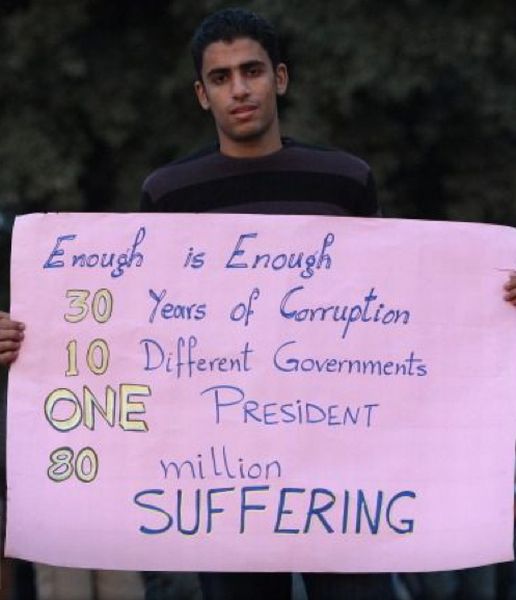
One would think that the recent events in Tunisia, Cairo, Yemen and elsewhere would demand soul-searching and humility on the part of these talking-heads who pontificate from their comfortable think-tanks and self-appointed analyst positions in Washington, London and Brussels....Nevertheless, they cling to the tired and discredited claim that building a few of apartments in Ariel is what drives the so-called "Arab street" to distraction. For those who don't read Arabic, many of those demonstrating in their capital cities wrote slogans in English to give a voice to their frustrations that the rest of the world could understand. 
I didn't see any signs about settlements, the Palestinians or the stalemate in the peace process on the streets of Tunis, Sanaa or Cairo. The few signs that did mention Israel were so monstrously antisemitic that they can be dismissed as the rantings of those who can not tolerate a Jewish presence anywhere in the Middle East and are hardly interested in any sort of peace process.
Bravo, Mr. Ayalon. Let world leaders wake up to the real issues that face the Arab world and all of us.


~glass of shiraz~

Sunday, February 13, 2011

Humanity, By the Pixels

World Press Photo recently announced the winners of its 2011 photojournalism contest. A non-profit organization based in the Netherlands, World Press Photo supports the development of photojournalism internationally, by holding this annual contest and exhibition, by organizing workshops and classes such as the Joop Swart Masterclass, and otherwise. 

A few which caught my eye:

A man and a boy, displaced by floods, walk through flood waters on August 22, 2010 in the village of Baseera near Muzaffargarh in Punjab, Pakistan. This photograph is part of a series that took the 1st Prize for People In The News Stories of the 2011 World Press Photo Contest. (Daniel Berehulak/Getty Images)


In this photo released by Word Press Photo, the 1st Prize Contemporary Issues Stories by Ed Ou, Canada, Reportage by Getty Images, shows four Somali refugees en route to Yemen sleep in the desert after traveling all night on muddy roads and in pouring rain, Somaliland, March 15, 2010. (AP Photo/Ed Ou/Reportage by Getty Images)

                 Amit Sha'al, Israel. Altneuland.


~mint tea~